

Speculative Decoding
The problem
Section titled “The problem”an LLM generates tokens one at a time (sequential):
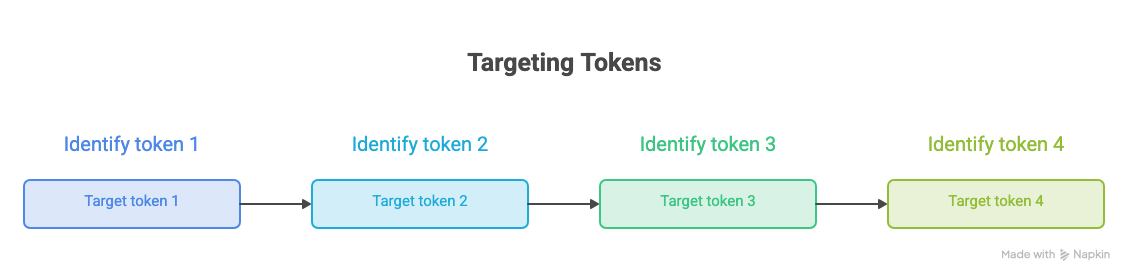
The → cat → is → sitting → on → the → matFor every new token, the large model has to run another forward pass.
How Speculative Decoding Solves the Problem
Section titled “How Speculative Decoding Solves the Problem”We introduce two models:
- Draft model - small and fast
- Target model - large and accurate
Example:
Prompt: "The cat is"
Draft model:    "sitting on the mat"
Target model:    verifies all these proposed tokens
without speculative decoding:
with speculative decoding:
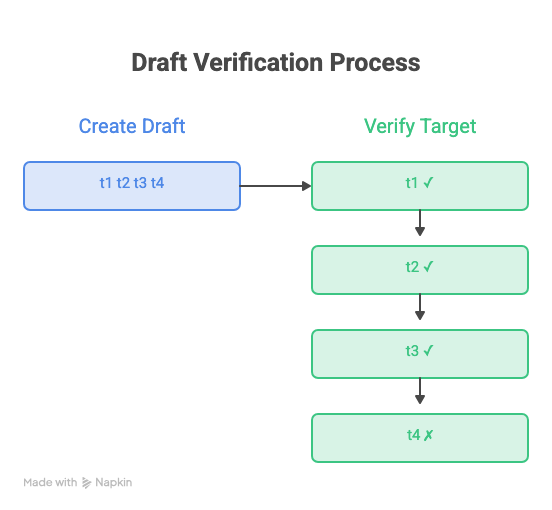
Key benefit: More accepted tokens per target-model forward pass
How it works
Section titled “How it works”Suppose the current sequence is:
The cat isStep 1: Draft model generates K tokens
suppose K = 4
The cat is sitting on the mat ↑ ↑ ↑ ↑ t1 t2 t3 t4Step 2: Target model verifies them
The large model processes the proposed sequence and produces probabilities for:
P(t1)P(t2 | t1)P(t3 | t1,t2)P(t4 | t1,t2,t3)Because transformers can process a sequence in parallel during the forward pass, the target model doesn’t need four completely separate forward passes just to evaluate those four proposals.
Step 3: Accept or reject
For each proposed token, we compare the draft model’s probability with the target model’s probability.
If the draft’s prediction agrees sufficiently with the target distribution, the token is accepted. If a token is rejected, generation falls back to the target model at that point.
Important concept: acceptance rate
Section titled “Important concept: acceptance rate”One of the most important metrics is the acceptance rate.
If the draft model proposes 5 tokens and the target accepts 4:
Higher acceptance generally means better speedup.
but there is a tradeoff:
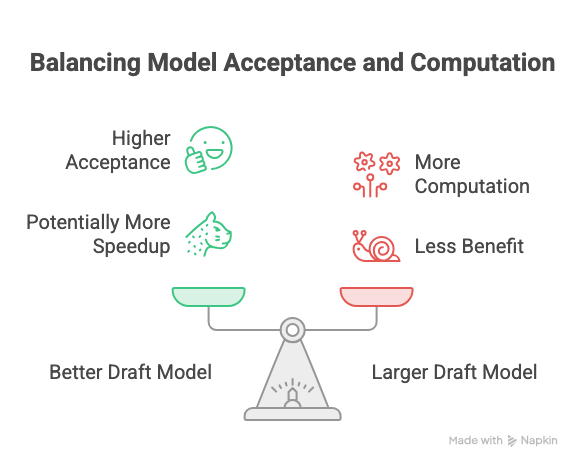
draft model should be cheap enough to run quickly + accurate enough to make useful predictions.
When does speculative decoding work well?
Section titled “When does speculative decoding work well?”It works particularly well when:
Draft and target models are similar
For example:
Small Llama model ↓Large Llama modelThe small model tends to predict similar continuations.
Relationship with KV Cache
Section titled “Relationship with KV Cache”This is important given what we just covered.
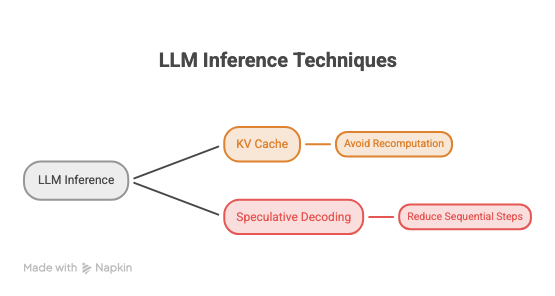
KV Cache:
Avoid recomputing previous attention states.
Speculative decoding:
Avoid making the large model generate every token sequentially.
They attack different bottlenecks.
Main Tradeoffs
Section titled “Main Tradeoffs”| Factor | Effect |
|---|---|
| Smaller draft model | Faster drafting |
| Better draft model | Higher acceptance |
| Higher acceptance | More speedup |
| Too many speculative tokens | More rejected work |
| Poor draft/target alignment | Low acceptance |
| Extra model | More memory/complexity |
The biggest engineering question becomes:
is the cost of drafting cheaper than the target-model computation it saves?
Interview mental model
Section titled “Interview mental model”The three things I’d remember are:
Draft → Verify → Accept/RejectMain benefit = fewer sequential target-model stepsKey metric = acceptance rate